

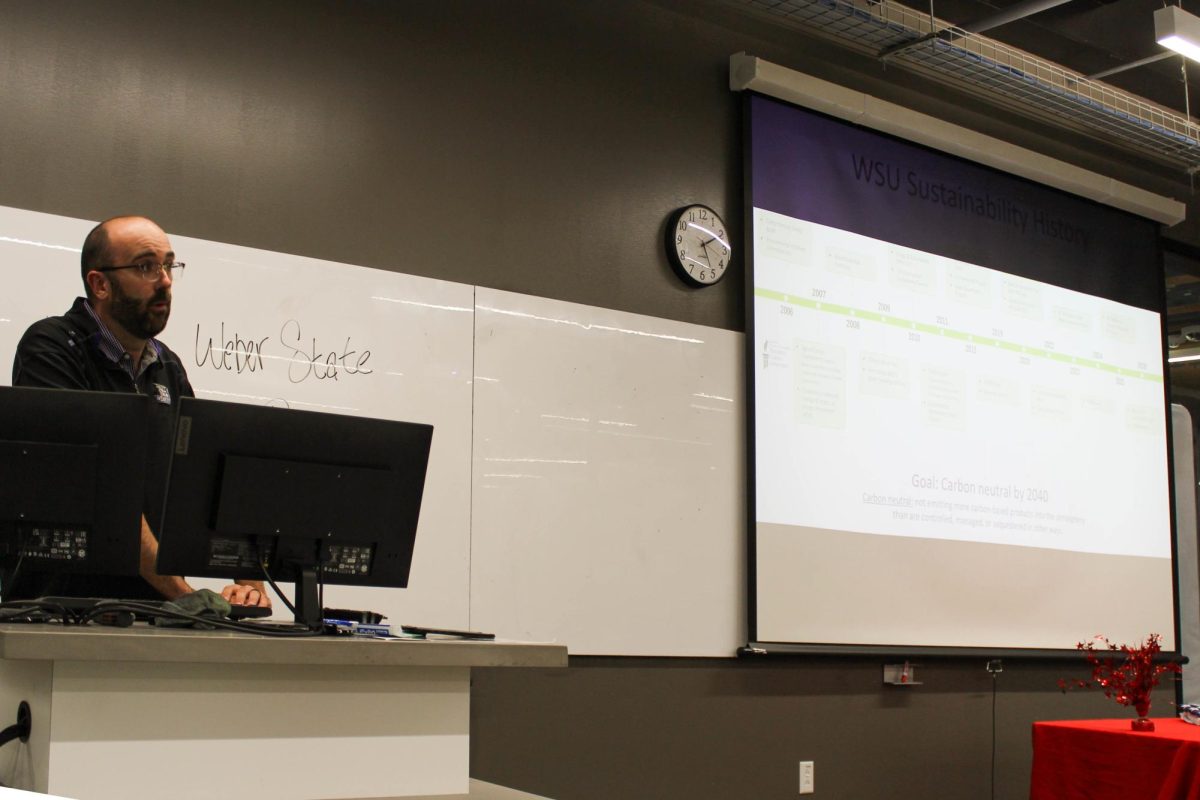
The Utah Federation of College Republicans invited many to an event on April 6 for an extended conversation about how both Weber State University and the Utah government are attempting to stop the state from running out of its natural resources. This event was directed by President of the Weber State chapter, Chase Smith, who split it into three phases. The first phase consisted of a walk through the Discovery Loop Trail north of campus that allowed those in attendance to see how much the Great Salt Lake has receded and explain the potential dangers of wildfires because of tree density.
“As the lake continues to recede … more and more of those chemicals are going to get thrown up into the air. The big one that people are worried about is cyanide. Not necessarily a chemical we want to be inhaling all the time,” Eric Walker, vice president of the Weber State chapter, said.
After the short hike, there was a presentation and tour of some facilities given by Weber State faculty members, Justin Owen and Jacob Cain. Owen is the director of Utilities and Sustainability at Weber and Cain is the associate vice president for Facilities and Campus Planning, but was also the one who originally put this plan together. During the presentation, Owen says that the system was put in place after a former president of the college made a pledge to make the campus carbon neutral by 2050, which is when they began developing the plans to begin this process.
“We were pushing for carbon neutrality, and part of it early on was just this look … everyone starts doing LED lighting, right? Everyone shows their path to carbon neutrality. And now it’s like, hey, we’re going to do these projects that knock 20% off their carbon. And then there’s this giant hole,” Cain said.
After LED lighting was installed, as it is a more efficient lighting source, Cain talked more about their decision-making process for deciding on this new system. Cain says that most organizations will just offset some practices like steam plants to help compensate and say they are carbon neutral, but Cain said Weber State and his department didn’t want to settle for offsetting their neutrality.
“How do you heat and cool a campus renewably? That’s a hard question. So it was a lot of just kind of looking at different ideas and kind of just came up with it,” Cain said.
That’s when the idea came to the team to take these three main technologies and combine them into a more efficient way of heating and cooling the entire campus.
The system uses heat pumps inside rooms instead of an HVAC system to siphon the heat into or from a room and input that energy into a system of pipes that are filled with water and some refrigerant that then takes the hot or cold liquid and displaces it to a different part of the campus to cool or warm a room that actually needs that energy.
If the system ever has too cold or too hot of refrigerant, that could potentially damage the system, it sends that energy deep into the earth, where it is quickly discharged through the deep earth and restored to a temperature of about 57 degrees Fahrenheit.
This system mixed with the energy production that both the Ogden and the Davis campuses have saved the school about $30 million in energy costs since the installation of the system.
“For us, this primarily is on-site solar. The Davis campus is just about electrically neutral. If it’s a bad solar year, we do buy from the grid a little bit. So we have 1.8 megawatts on the Davis campus, and we have about 1.5 megawatts on the Ogden campus,” Owen said.
In addition to these efforts to reduce energy usage and make the campuses energy efficient, there are batteries that have also been installed to store any excess energy during the cheaper months of the year that can be used as backups in the case of emergencies.
“We have a battery storage system on campus now. If campus loses power, the batteries turn on — take over and they can run campus for two hours without even thinking about it,” Owen said.
The amount of energy and money that is saved through this new combination of systems is so grand that it has brought the attention of multiple universities across the country. Owen and Cain said that they are constantly giving weekly presentations to many different organizations to explain their findings and how it all works. The system takes some time to pay for itself but with how efficient it is Owen and Cain are sure that most will see the results and adopt the system even if just a little at a time.
Rep. Jill Koford of District 10 was also in attendance for the presentation and tour. “I think there’s a huge opportunity there to say, ‘Look, Weber State is leading out in so many things, and in the sustainability focus, they are on the cutting edge.’ So how do we replicate that across all of our institutions of higher education?”
Koford also serves on the Higher Ed Appropriations Committee and was excited to have met Owen and Cain and wants to have them educate some of the other universities on what they’ve been able to accomplish. Koford said she is hopeful that not only will other higher educational institutions adopt this system and see its value but also that governmental buildings can be an example of looking toward the future and adopting the idea of sustainability and longevity that this can bring.
“Let’s show the rest of the state what that looks like. But maybe we need to think about that in terms of energy and sustainability and where we can make that pencil, because it’s got to make sense financially,” Koford said.
The third phase of the event included Koford alongside the Deputy Great Salt Lake Commissioner Hannah Freeze and the Executive Director for Natural Resources Joel Ferry, in a panel discussion about conservation efforts for the Great Salt Lake. The panel lasted about an hour, which discussed questions moderated by Smith, followed by questions from the audience.
The message that was consistently displayed by the panelists was that the issues of conservation of the Great Salt Lake were nonpartisan and conservation efforts are being pushed by the people of Utah to continue to see our state flourish.
“I think one behavior that I’m also guilty of that we need to maybe get over is thinking that it’s someone else’s problem. Well, my lawn can be green, but my neighbor ought to be doing something else,” Freeze said.
Correction: An earlier version of this story misspelled Justine Owen’s name as Justin Owens and incorrectly listed the date of the conference as March 6 instead of April 6. The errors have been corrected.










Your wife • Apr 23, 2026 at 7:15 am
such wow